Isidor FUCHS was born on June 18, 1885 in Buttenwiesen bei Augsburg, Bavaria. He was a son of the Jewish couple Julia FUCHS née Schönbrunn, and Ludwig FUCHS (who died in Munich in 1891).
In 1898 the widow Julia FUCHS moved from Munich to Salzburg with her 13-year-old son Isidor (Dorl) in order to join her family – which consisted of Julia’s parents, Karoline and Elias Schönbrunn, Julia’s sister Johanna with her husband Rudolf LÖWY, and Julia’s daughter Amalie with her husband Oswald LÖWY.
Isidor FUCHS learned the business of the shop of his brother-in-law Oswald LÖWY at 6 Mirabellplatz – across the street from Schloss Mirabell – and then worked there as a sales clerk.
Isidor FUCHS remained a German citizen, and a Bavarian patriot, so he served in the Bavarian Infantry Regiment No. 2 for three and a half years during the First World War, ending as a clerk in a Munich military hospital.
At the end of the war, 33-year-old Isidor FUCHS returned to Salzburg and began to work again for his brother-in-law Oswald LÖWY. But before long, he set up his own business in Salzburg. In November 1921, Isidor FUCHS founded the company Fuchs & Co. (wholesale haberdashery and knitwear) with Manfred BONYHADI. They started off in the building at 6 Mirabellplatz, but then moved to the 1st floor of a building in the Old Town across the river at 21 Getreidegasse where the ground floor housed a busy shoe store.
In December 1921, at age 36, Isidor FUCHS got married in Prague [Praha], the capital of Czechoslovakia. His wife, Martha, had been born on June 4, 1891, in Leitmeritz near Theresienstadt [Litoměřice near Terezin], and was one of the five children of Klara Steindler née Kornfeld and Richard Steindler. Martha’s eldest brother, Ernst Steindler, had been killed on the Isonzo front in the First World War.
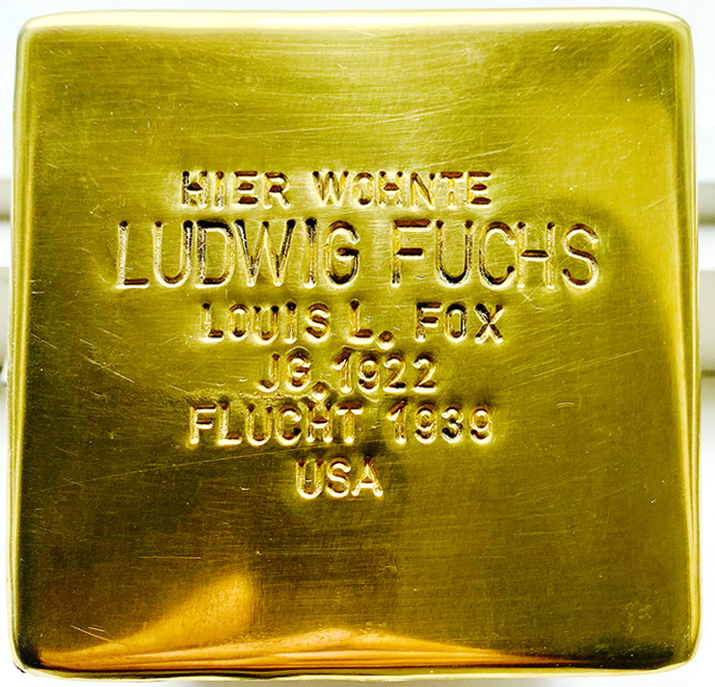
Martha and Isidor FUCHS had a son, Ludwig (named after his grandfather, who had died in Munich in 1891), on October 3, 1922, in Salzburg. Ludwig (nicknamed Vigo) celebrated his Bar Mitzvah at the Salzburg synagogue at 8 Lasserstrasse in 1935.
Martha’s younger sister Elisabeth (Else or Elise) Steindler married Isadore’s business partner Manfred BONYHADI. The BONYHADI couple had a son named Ernst, who was born in Salzburg on January 3, 1924. Vigo’s cousin and close friend Ernie had his Bar Mitzvah in the Salzburg synagogue in 1937.
In March 1929, Julia Fuchs died at the age of 75. She was the mother of Amalie, Jenny and Isidor, the grandmother of Ludwig, Robert, Paul, Emil and Grete LÖWY, of Franz and Louis Nalos (in Prague) and of Ludwig FUCHS, buried in the Jewish cemetery in Salzburg.
For about fifteen years, the family of Martha, Isidor, and Ludwig FUCHS lived in the house at 1 Elisabethstrasse, on the first floor – in comfortable middle-class circumstances.
Two houses in their neighborhood belonged to the Jewish couple Gottlieb and Hermine Winkler: Houses that were called »Jew houses« in anti-Semitic Salzburg – the homes of the Jewish families MORPURGO and EISENBERG with a total of six children.
Antisemitic Salzburg knew the names and addresses of its hated Jewish competitors: Isidor FUCHS first appeared on the Jewish boycott list published by the Salzburg Antisemitic League in its newspaper »Der eiserne Besen« (The Iron Broom) in November 1923 – with the stated goal of destroying the existence of all Jews in their city.
Isidor Fuchs was still an active member of his Jewish community in the 1930s: protesting against the persecutions in Nazi Germany and also against anti-Semitic activities in Salzburg – but this went unnoticed by the local press.
When Rabbi Dr. David Samuel MARGULES opened a library in in the Salzburg synagogue in 1937 it went largely unnoticed. But the names of the book donors are known: Isidor FUCHS, Daniel BONYHADI, Otto LÖWY und Stefan ZWEIG. It was an exquisite Jewish library, one that disappeared without a trace under the Nazi regime – not even in the family memories of the survivors.
In the violent year of 1938, Isidor FUCHS was 53 years old, his wife Martha 47 years old, and their son Ludwig (Vigo), who had graduated from a hotel management school in Vienna, was only 16 years old.
The hatred of Jews erupted: at the end of May 1938, the family of Isidor FUCHS, all of whom were German citizens, was evicted from their rented apartment in the house at 1 Elisabethstraße (the beneficiary was the physician Dr. Johann Graetz).
Isidor, Martha and Ludwig found refuge with their friends, the BONYHADI family – until the »Reichskristallnacht« pogrom of November 9th to 10th, 1938, when their existence in Salzburg was finally extinguished and Fuchs & Co. was liquidated.
On the orders of SS-Sturmbannführer Karl-Heinz Rux, the Salzburg Gestapo deported 26 Jews, including Isidor FUCHS and Manfred BONYHADI, to the Dachau concentration camp: Prisoners No. 22927 and 22928 arrived on November 12, 1938, and were released on December 22, 1938, on the condition that they »emigrate« immediately with their families – robbed and expelled.
Even while Isidor and Fred were still imprisoned in the concentration camp, their wives and sons had to travel to Vienna with packed suitcases. In Vienna, however, both families were fortunate: They received visas for the USA, tickets for ship passages to New York, and support affidavits from a US citizen (Moses E. Steinberg from Portland, Oregon).).
The two families managed to escape only after the outbreak of World War II, but before Italy declared war: they traveled from Genoa to New York on November 6, 1939, on the Italian transatlantic liner Saturnia, arriving on November 17, 1939. Their new home was Portland in the US state of Oregon on the west coast of the USA: a life in freedom, but in precarious circumstances and with a changed family name: FOX instead of FUCHS.
During World War II, the young Ludwig FUCHS served in the US Army as Louis L. FOX.
His mother, Martha FOX, died of cancer on January 11, 1946, at the age of 54; his father, Isidore FOX, died at the age of 88 on September 1, 1973, in Portland (both in Cemetery Ahavai Sholom). The grave of Julia FUCHS, Isidor’s mother and Ludwig’s grandmother, who died in Salzburg in 1929, no longer exists – it was destroyed under the NAZI regime, as were the registration books of the Jewish community of Salzburg containing Ludwig FUCHS’ birth record from 1922.
Thanks to the initiative of the President of the Jewish Community of Salzburg, Marko Feingold, editor of the book An Eternal Nevertheless: 125 Years of Jews in Salzburg, the surviving expelled Jewish women and men were invited to Salzburg in August 1993.
Among the guests were 71-year-old US citizen Louis L. FOX, formerly Ludwig (Vigo) FUCHS, his wife Barbara Suzanne, and their daughter Rebecca. Their first visit together was to the former FUCHS family home at 1 Elisabethstrasse which had been stolen in 1938:
… When we first returned to Salzburg, I went straight to our old house on Elisabethstrasse and asked permission to see my apartment so I could show it to my wife and daughter.
The lady who lives there now is a relative of the surveyor who owned the house, a daughter or something. And she gave my wife a beautiful embroidered tablecloth, a tablecloth she had received as a gift from my mother!
I haven’t thought about what happened in Salzburg that often. They say you never forget, but it wasn’t something I thought about every day or every month.
(Salzburg Jews tell their stories, p. 157)
In his narrative, published in 1998, the names of his family’s murdered members, whose memories are deeply ingrained in his family, remained unmentioned.1
Louis L. FOX, who was able to spend his retirement with his wife Barbara Suzanne at the home of their married daughter Rebecca Norman, died at the age of 101 on March 31, 2024 in Randallstown Maryland near Baltimore (Cemetery Liberty Park of Shaarei Zion).
Sources
- Standesamt Buttenwiesen (Family of Julia and Ludwig Fuchs, German Citizenship)
- Jewish Community/Israelitische Kultusgemeinde Salzburg (Birth and Marriage records destroyed by the Nazi regime)
- Salzburg City and State archives (police registration and business records)
- Dachau Concentration Camp Memorial Site
- Arolsen Archives
- Documentation Archives of the Austrian Resistance
- Yad Vashem (Shoah-Victims)
- Marko M. Feingold (ed.): Ein ewiges Dennoch. 125 Jahre Juden in Salzburg, Vienna 1993
- Gert Kerschbaumer: »Geschichte schreiben nach Auschwitz«, in: Die Gemeinde, offizielles Organ der IKG Wien, Nr. 428, 6/10/1993
- Geduldet, geschmäht und vertrieben. Salzburger Juden erzählen, Ed.s Daniela Ellmauer, Helga Embacher and Albert Lichtblau, Salzburg 1998, pp. 147-157
- Albert Lichtblau: »Arisierungen«, beschlagnahmte Vermögen, Rückstellungen und Entschädigungen in Salzburg, Vienna-Munich 2004, p. 174
Translation: Stan Nadel
Stumbling Stone
Laid 06.10.2026 at Salzburg, Elisabethstraße 1
 Ludwig (Wigo) Fuchs, age 16, 1938/39
Photo: private collection
 Isidor Fuchs in a Bavarian uniform (World War I)
Photo: private collection