Franz DÜRNBERGER was born in Hofgastein (about 60 miles south of Salzburg) on October 5, 1903 and was baptized in the Roman Catholic Church. He was the youngest of the seven sons of Maria and Friedrich Dürnberger. His father was a forester in Hofgastein (which was renamed Bad Hofgastein in 1936).
Franz graduated from the Archbishop’s High School Borromäum and the seminary at 14 Dreifaltigkeitsgasse in Salzburg.
Franz DÜRNBERGER was ordained in the Salzburg Cathedral by Archbishop Dr. Ignaz Rieder on July 18, 1926.
Franz DÜRNBERGER initially served as a curate in St. Johann im Pongau (60 miles south of Salzburg), then for seven years as cathedral preacher in Salzburg, and from June 1941 on as parish priest (head priest) in the Gnigl district of the city of Salzburg, at 58 Eichstraße.
Under the Nazi regime, the Roman Catholic Church was subjected to an aggressive anti-clerical campaign, and approximately 150 priests of the Archdiocese of Salzburg were »banned from teaching«. They were banned from entering or teaching in the public schools.
Beyond that, their pastoral care in churches and cemeteries was monitored to prevent any commemoration of people who were considered »unworthy of life« (i.e. severely handicapped) or accused of »high treason and treason against the state«. Which means that Franz DÜRNBERGER’s pastoral care can be summarized as Christian resistance and civil courage.
As parish priest of Gnigl, he held requiem masses for victims of Nazi terror immediately upon taking office in the war year of 1941: notably on the occasion of the urn burials with their bereaved families at the Gnigl cemetery for Marie WURM and Theresia TRENKE, two handicapped women murdered by the Nazis in the Hartheim killing center near Linz.
The so-called »euthanasia« killings that were carried out as part of the Nazi’s secret »T4«1 operation do not even appear in the police registration files, but the Nazi regime was unable to maintain strict secrecy.
What did the civil society know about the 35 death sentences handed down by the »People’s Court« at the Salzburg Regional Court? The Nazi press remained silent on the matter in order to create the impression that there was neither resistance nor a struggle for freedom.
For example, on April 6, 1943, the »People’s Court Judge« from Berlin Walter Hartmann, sentenced four activists of the illegal Communist Party of Austria to death at the Salzburg Regional Court, including the 32-year-old electrical engineer and teacher Anton SCHUBERT from Gnigl. He was guillotined in the München-Stadelheim prison on July 22, 1943. His body was not buried in Munich, but rather handed over to the anatomical institute of the University of Würzburg for study purposes, something no relative in Salzburg would have known.
Anton SCHUBERT’s parents Thekla and Anton, his brother Richard, his wife Elisabeth and his children Anton and Elisabeth received touching farewell letters from his death cell. It was a traumatic event for the grieving family, who wanted to say goodbye to their Toni in their parish church in Gnigl. At the request of his mother Thekla, Fr. Dürnberger held a requiem mass for her son, who had been executed in Munich.
Someone from the parish denounced the courageous priest to the Gestapo for having celebrated a Mass for an opponent of the regime, but the priest did not want to suspect or accuse anyone of denunciation.
Looking back Franz DÜRNBERGER wrote:
The accused held a mass at the request of the mother of an executed freedom fighter, and this was considered anti-state and anti-people behavior according to the protective custody order.
(Victim’s compensation file)
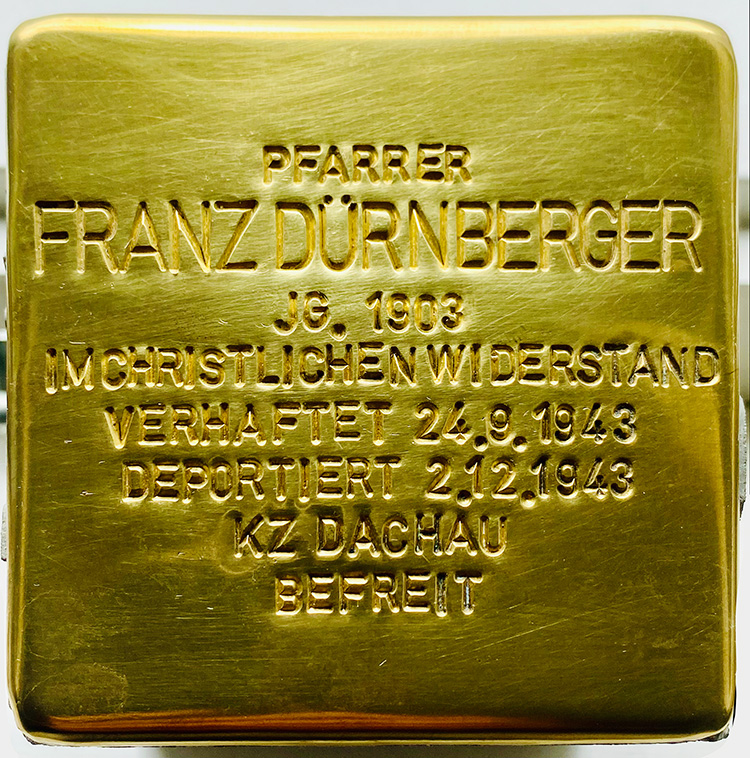
The dates of the Nazi persecution of Franz DÜRNBERGER were documented: arrest on September 24, 1943, police prison at Rudolfsplatz until November 28, 1943, deportation to the Dachau concentration camp, entry as »protective custody prisoner Pf.« (priest) number 58980 on December 2, 1943.
These official records don’t note the death of his 78-year-old mother Maria from Bad Hofgastein on November 30, 1943. She died while her youngest son Franz was imprisoned in Salzburg, so he was prevented from saying goodbye to his mother or holding a funeral mass for her.
Dachau concentration camp prisoner No. 58980 survived the years of terror: Pastor Franz DÜRNBERGER was released from the concentration camp on April 5, 1945 – shortly before its liberation by US troops.
His first stop was his hometown of Bad Hofgastein, where his brothers Anton and Johann still lived and where their parents’ grave was located. From there, he went to his parish in Gnigl, at 58 Eichstraße.
Concentration camp for reading the Mass:
On Sunday, June 17, parish priest Franz Dürnberger returned to his Gnigl parish, a day celebrated with great warmth by the entire parish. […]
The day he resumed his ministry at his former parish was marked with festivities. The church was decorated when Father Dürnberger held his first service on Sunday. In a moving sermon, he vividly illustrated to his parishioners the suffering of the many unfortunate people imprisoned in concentration camps. The day of his return was a day of joy for the entire parish of Gnigl.
(Salzburger Nachrichten, June 18, 1945, p. 2)
Franz DÜRNBERGER, appointed »Spiritual Councilor« in 1947, was a courageous priest who was able to perceive the suffering of others – beyond the liberation year of 1945, and also during the Cold War or East-West conflict with its deeply divided culture of remembrance.
In this regard It is particularly noteworthy that on Sunday, December 14, 1952, Pastor Franz DÜRNBERGER participated in an event organized by the Salzburg Concentration Camp Association to commemorate four communist resistance fighters executed in Munich-Stadelheim: Heinrich AUER, Rudolf SMOLIK, Karl SCHALLMOSER and Anton SCHUBERT, He apparently performed a blessing for these victims of terror in the municipal cemetery, an event which was only reported in the communist press. (Salzburger Tagblatt, December 15,1952, p. 3).2
In the Salzburg municipal cemetery, the Salzburg Concentration Camp Association’s graves for communist resistance fighters (with the association’s emblem and inscription – »They died for Austria in 1943«) have been official honorary graves of the city of Salzburg since 2015.
The priest Franz DÜRNBERGER, himself a recognized »victim of the struggle for a free, democratic Austria«, died in Salzburg at the age of 70 on January 30, 1974, and is buried in the St. Peter cemetery. But, in the public spaces of the city of Salzburg, there is no path or square that bears the name Franz Dürnberger, or honors his pastoral care and civic courage.
The main perpetrators of the murders of the handicapped in Salzburg were: Dr. Friedrich Rainer as Reich Governor, Dr. Oskar Hausner as head of the Gau Welfare Office, Dr. Leo Wolfer as head of the State Sanatorium and Dr. Heinrich Wolfer as head of the Hereditary Biology Department of the State Sanatorium (today Christian Doppler Clinic).
2 The Salzburger Tagblatt newspaper reported on December 15, 1952, that Heinrich AUER, Rudolf SMOLIK, Karl SCHALLMOSER and Anton SCHUBERTthat the remains were exhumed in Munich-Perlach at the initiative of the Salzburg Concentration Camp Association and ceremonially reburied in the municipal cemetery on December 14, 1952. However, it is documented (in the Arolsen Archives) that the bodies of these victims of terror were transferred to the anatomical institute of the University of Würzburg for research purposes in 1943, and therefore could not have been exhumed in Munich-Perlach.<
Sources
- Archives of the Archdiocese of Salzburg and Regesta Ecclesiastica Salisburgensia (Priest Franz Borgias Dürnberger)
- Salzburg Provincial Archives (Victims’ Welfare File S-524)
- Salzburg City Archives (Resident Register)
- Resistance and Persecution in Salzburg, Volume II, pp. 263–265, 289ff, 315ff.
- Arolsen Archives (Documents on Political Persecution)
- Salzburg Church Gazette (July 15, 1926, 11; Sept. 8, 1927, 6; Nov. 17, 1938, 6)
- Salzburger Nachrichten (June 16, 1945, 2: Concentration Camp for Reading the Mass; July 5, 1945, 2: Priest in the Dock)
- Salzburger Tagblatt (July 22, 1946, 4: Obituary for Anton Schubert, December 15, 1952, 3, Commemoration by the Salzburg Concentration Camp Association at the municipal cemetery)
Translation: Stan Nadel
Stumbling Stone
Laid at Salzburg, Eichstraße 58
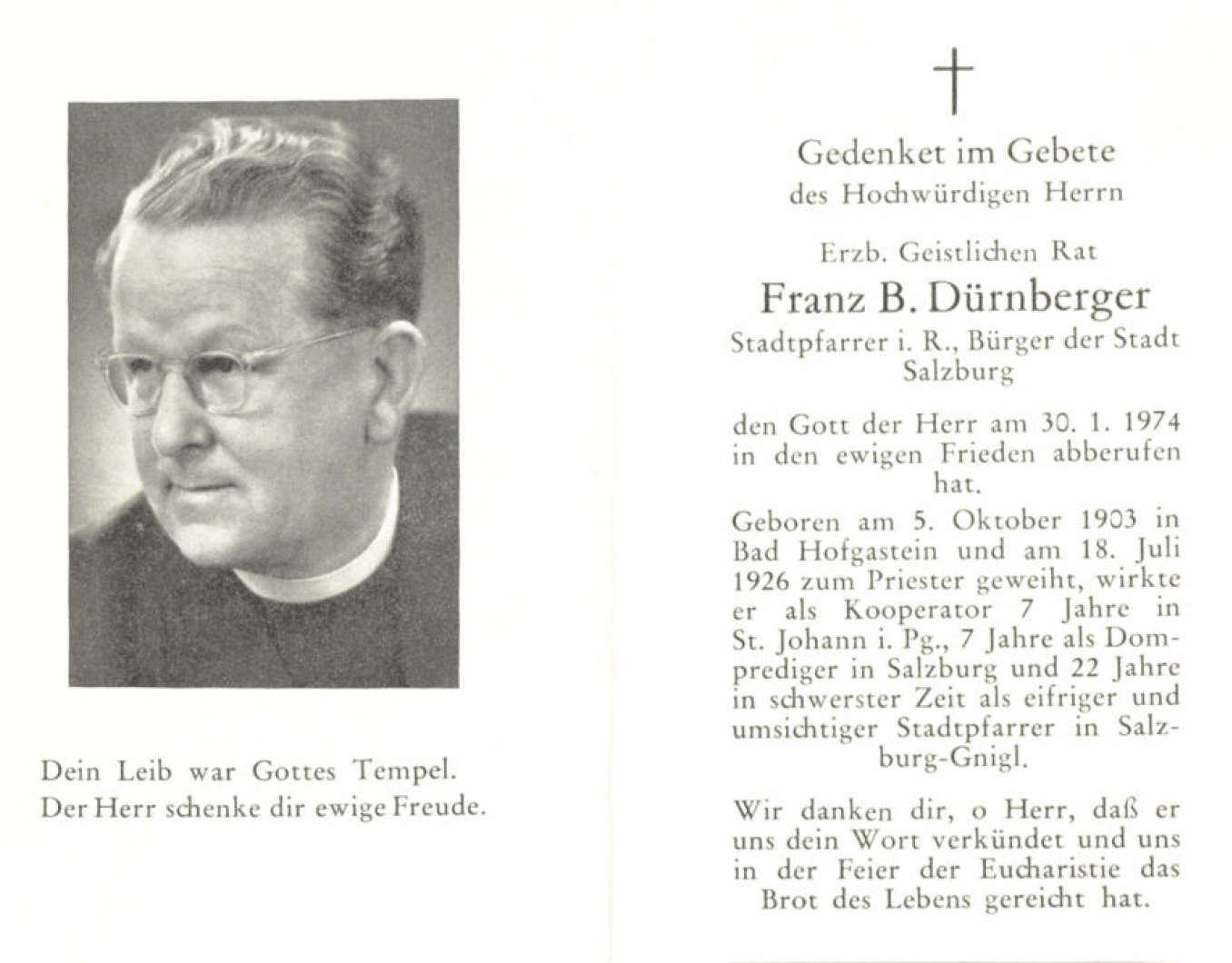 Death notice Franz Dürnberger
Source: Archives of the Archdiocese of Salzburg