Julius POLLAK was born in Hartmanitz (Hartmanice), Klattau District (Klatovy), in the Bohemian Crown Land of Austria-Hungary (now the Czech Republic) on March 31, 1878. He was the youngest of the six children of the Jewish couple Elisabeth Pollak née Hahn and Markus Pollak. Markus was a manufacturer and chairman of the Jewish community of Hartmanitz in Bohemia.1
Julius POLLAK studied law at the Charles-Ferdinand University in Prague (Praha), he initially practiced law in Carlsbad (Karlovy Vary), where he married Frieda Glaser, the daughter of Therese and Dr. Benno Glaser (district physician in Hartmanitz, Bohemia).
On January 6, 1910 Frieda POLLAK gave birth in Carlsbad (Karlovy Vary) to their daughter Ilse.
In 1910, while the Austro-Hungarian monarchy was experiencing an era of peace and prosperity, the family moved to Salzburg – where Dr. Julius POLLAK set up a law office. At first it was located at 8 Getreidegasse, but at the beginning of June 1911 it was moved to the first floor at 8 Makartplatz (the house where Mozart had grown up).2
Dr. Julius POLLAK was active on the board of the official Salzburg Jewish community and – like Sigmund Freud, it should be noted – a member of the B’nai B’rith fraternal order.
It is also worth noting that Dr. Julius POLLAK was an advisor to and defender of ordinary workers, as well as legal representative of the Social Democratic Workers’ Party and lecturer at its workers’ school in the Salzburg House of Labor.
Dr. Julius POLLAK was attacked as a »Jewish party advocate«. In November 1923 his name appeared for the first time on the anti-Jewish boycott list of the Salzburg Anti-Semitic League’s hate-filled newspaper Der eiserne Besen [The Iron Broom] – which had the explicit goal of destroying the economic existence of all Jews in Salzburg.
After the collapse of the Austro-Hungarian monarchy, the POLLAK family was able to acquire Austrian citizenship and local citizenship rights in the Salzburg-Maxglan district without hindrance. They lived in the house at 12 Wiesbauerstraße (which they had owned since 1917).3
Their daughter Ilse studied German philology at the University of Vienna, received her doctorate (Dr. phil.) on June 17, 1932 (dissertation on the influence of French Symbolists on Stefan George and his circle), and subsequently married Dr. Franz Grün – who had been born on May 14, 1903 in Kremsier (Kroměříž, now in the Czech Republic), and who had studied law at the University of Vienna.4
Ilse and Franz GRÜN had been living at 9 Wiesbauerstraße in Maxglan, since the beginning of 1933, and had a son named Ernst there on September 24, 1933 – it was the last birth of a Jewish child registered in Salzburg before the elimination of the Jewish Community in March 1938.
No Jewish family could feel safe In Salzburg after it became a border town with Nazi Germany after 1933, but it was generally Austrian Nazis who carried out bomb attacks against social-democrats and Jews in Austria. One of the bomb attacks was at the home of the POLLAK-GRÜN family at 9 Wiesbauerstraße on May 10, 1934. Their hometown of Maxglan had a social democratic mayor until the Social-Democratic Workers’ Party was crushed by the new Austro-fascist regime that same year.
Attorney Dr. GRÜN was a partner with his father-in-law Dr. POLLAK in the Makartplatz bureau and under the Austrian fascist dictatorship from 1933 to 1938, he too was a defender of Social Democrats, along with the new Austrian Revolutionary Socialists (RSÖ) organization. He was the defense attorney for their Salzburg state leader Josef PFEFFER 5 in the Socialist Trial of December 28, 1936.
Dr. GRÜN was also an active member of the Jewish community in Salzburg: protesting against the persecutions in Nazi Germany and also against anti-Semitic activities in Salzburg – but this went unnoticed by the local press.
Antisemitism exploded under Nazi rule: in March 1938, Jewish lawyers were banned from practicing law, expelled and robbed, and their livelihoods were destroyed.6
The POLLAK-GRÜN fled to Prague on March 12, 1938 and then got visas and tickets for South America. They traveled to Genoa, where they boarded the Conte Grande on September 15, 1938, and arrived in Montevideo, Uruguay on October 2, 1938.
However, the POLLAK-GRÜN family was plagued by misfortune: On October 20, 1938, soon after their arrival in Montevideo, Julius POLLAK died there at the age of 60, and on May 2, 1941, his wife Frieda died at the age of 53. (Cementerio Israelita de La Paz bei Montevideo).
After the war ended, Ilse, Franz and Ernst GRÜN found another refuge: Buenos Aires in Argentina.
Their houses in Salzburg-Maxglan, stolen by the Nazis and occupied by SA Brigade 98 and SS Standard 76 until May 1945 – were restored to the heiress Dr. Ilse GRÜN in 1948. But she sold them because none of the surviving family members wanted to return to live in the place where their livelihoods had been destroyed.
During the Nazi terror years, the marriage and birth registers of the Jewish community of Salzburg were destroyed – Jewish identity was erased from Salzburg.
Ernst GRÜN, the son of Dr. Ilse and Dr. Franz GRÜN, born in Salzburg in 1933, left behind a remarkable legacy in exile:
Ernesto GRÜN (GRUEN), Doctor en Derecho y Ciencias Soziales por la Facultad de Derecho de la Universidad Nacional de Buenos Aires, was married twice, had four children and died in Buenos Aires at age 90 on March 14, 2024.
Finally, it should be noted that there is no street in the public space of the city of Salzburg that bears the names of either Dr. Julius POLLAK or Dr. Franz GRÜN to honor their dedicated defense of workers and persecuted socialists like Josef PFEFFER under Austro-fascism.
1 Dr. Julius Pollak’s parents: Elisabeth Pollak née Hahn, died in 1907, and Markus Pollak died in 1908 (both were buried in the Hartmanitz Jewish cemetery which was destroyed by the Nazis), while two of his siblings, Sigmund Pollak and Regine Zuzak née Pollak, were Holocaust victims.
2 Salzburg, 8 Makartplatz: formerly Leopold Mozart’s residence and was owned by Johann Wibmer, his widow Anna and daughter Anna Gildinger before May1938; then it was occupied by the Salzburg Gaufrauenschaft (the Nazi’s Regional Women’s Organization) until the Mozarteum Foundation took it over in June 1939, the building is now a historical landmark.
3 Salzburg-Maxglan, 12 Wiesbauerstraße: 1917 property of Frieda and Dr. Julius Pollak; confiscated in 1938—expropriated for Reichsgau (Nazi State) Salzburg (SA-Brigade 98); 1948 returned to Dr. Ilse Grün; sold in 1957 (real estate registration record EZ 655).
Salzburg-Maxglan, 9 Wiesbauerstraße: 1928 property of Frieda Pollak; confiscated in 1938– expropriated for the Nazi Party (offices for SS-Standarte 76); May 1945 turned over to the Jewish Committee (concentration camp survivors); 1948 returned to Dr. Ilse Grün; sold in 1957 (real estate registration record EZ 830).
4 Dr. Franz Erich Grün’s parents were: Irene Grün née Hajek, and Julius Grün, at 69 Josefstädter Straße. His sister, Dr. Amalie Grün, was born in Vienna in 1911, became a medical doctor, married Erwin Paneth in 1938 and died in San Antonio, Texas in 2002.
5 Josef Pfeffer, regional leader of the Revolutionary Socialists, was imprisoned for ten months on December 28, 1936; in 1938, he was sentenced to 18 months by the People’s Court in Vienna; in 1940, he was deported to the Sachsenhausen concentration camp, where he was murdered on February 28, 1945.
6 The person primarily responsible for the destruction of Jewish lawyers’ livelihoods was Dr. Robert Lippert, acting head of the Salzburg Bar Association in 1938, then »Reichsgau Chamberlain«, imprisoned in 1945, from 1957 onwards he was a member of the Salzburg city council and then senator.
Sources
- Jewish Communities of Hartmanitz, Karlsbad, Vienna and Salzburg (Birth and Marriage Registers destroyed by the Nazis)
- Archive of the University of Vienna (Dr. Ilse Pollak and Dr. Franz Grün)
- City and State archives of Vienna and Salzburg (police registration files, local citizenship files, real estate registration records Salzburg-Maxglan EZ 830, 655)
- Widerstand und Verfolgung in Salzburg, vol. I, pp. 45-48 (Socialist Trial, defense counsel Dr. Franz Grün not identified)
- ANNO (Austrian Newspaper Online)
- Centro de Estudios Migratiorios Latinoamericanos (CEMLA)
Translation: Stan Nadel
Stumbling Stone
Laid 06.10.2026 at Salzburg, Makartplatz 8
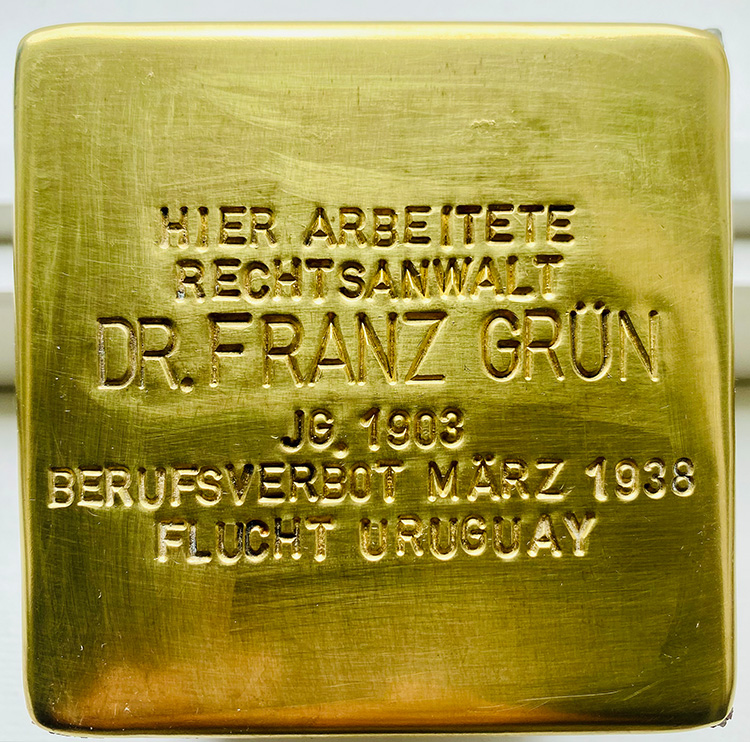
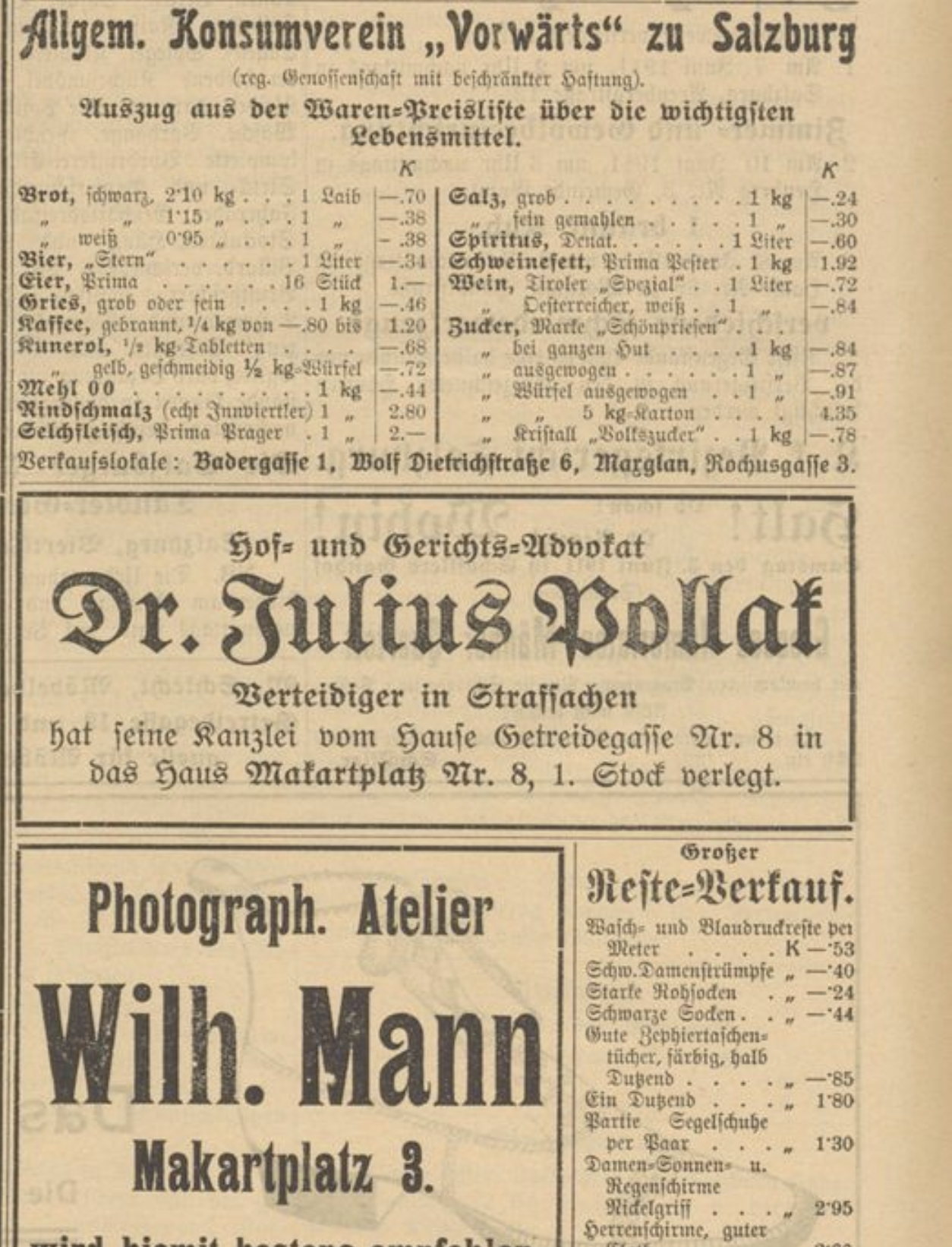 Law Office of Dr. Julius Pollak, Makartplatz 8, 1st Floor
 »Salzburger Wacht«, June 3, 1911, p. 8
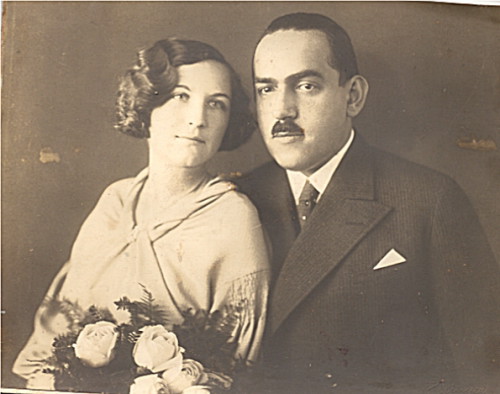 Dr. Ilse Grün-Pollak & Dr. Franz Grün at their wedding in 1933
Photo: private collection
 Dr. Ernesto Grün, Buenos Aires
Photo: private collection